Thank you for the information. I understand that Bianbu 2.0 and its family versions are LTS releases, so I will continue analyzing this issue on Bianbu 2.0 and its family versions.
My apologies for the late reply – I’ve only recently had time to look into this issue. I’ve confirmed that the problem has nothing to do with QEMU itself, but rather with the process permission management of Podman.
The root cause of the illegal instruction exception is that the code generated by QEMU JIT fails to update the instruction cache (ICache). This causes the CPU to fetch stale data, or even bytes that do not form a valid RISC-V instruction at all – hence get the illegal instruction exception.
QEMU is unable to update the ICache promptly because, when running in the Podman-managed container environment, its riscv_flush_icache system call is blocked/restricted.
I recommend launching the container with the --privileged flag, and this exception will be resolved.
podman run --privileged -it --name test-qemu ubuntu:24.04 /bin/bash
You may check the file /usr/share/containers/seccomp.json — you will find that the riscv_flush_icache system call is not included in Bianbu 2.0 OS, whereas it is present in Bianbu 3.0 OS
Alternatively, the issue can also be resolved by adding the riscv_flush_icache syscall item to the syscalls node in the /usr/share/containers/seccomp.json configuration file.
              {
                        "names": [
                                "riscv_flush_icache"
                        ],
                        "action": "SCMP_ACT_ALLOW",
                        "args": [],
                        "comment": "",
                        "includes": {
                                "arches": [
                                        "riscv64"
                                ]
                        },
                        "excludes": {}
                },
Excellent. This option works.
Good job 

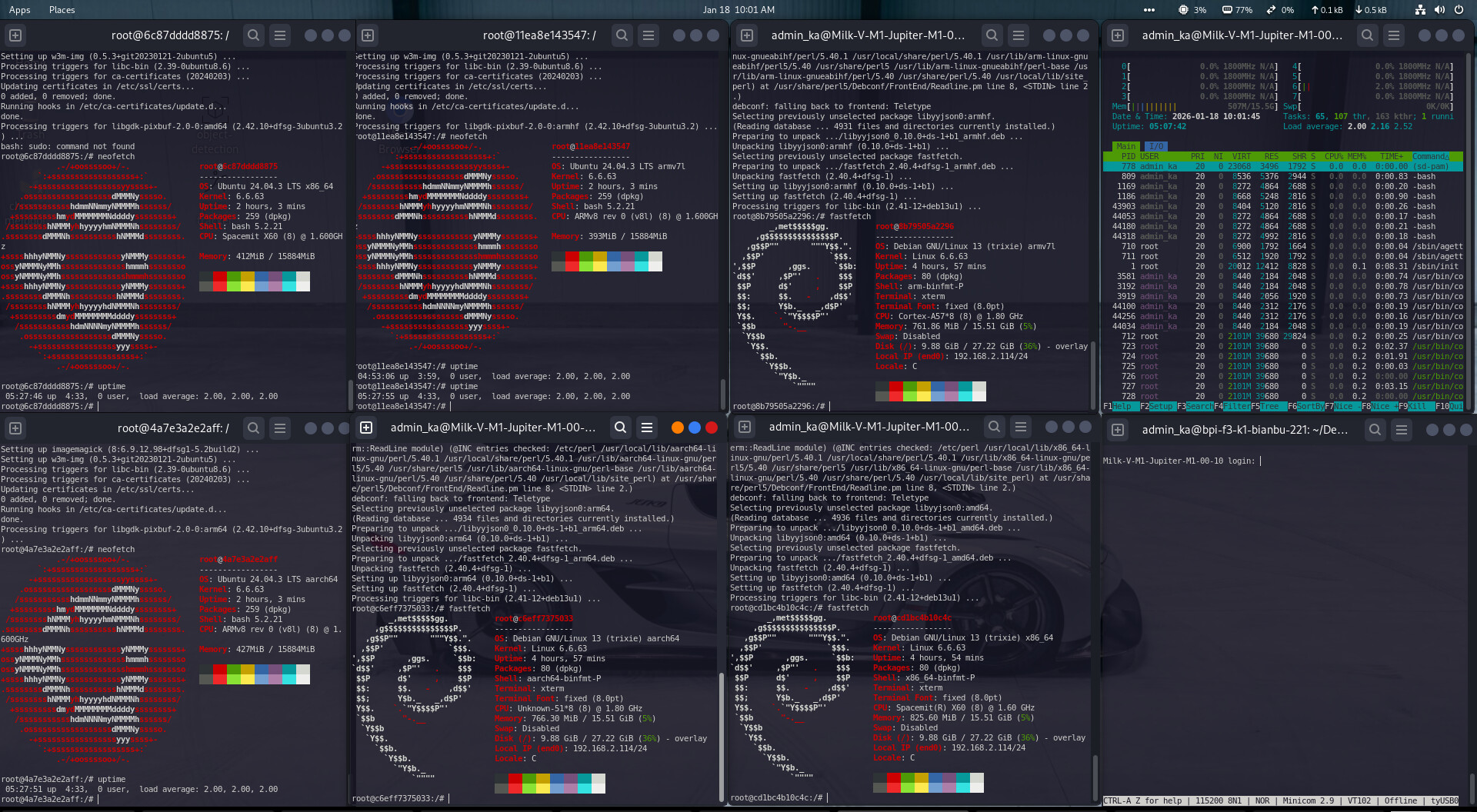
Version 10.1.3 of qemu, built manually using the same steps we’ve already followed, works perfectly.
However, I decided to test the behavior of the version of qemu-user-static-8.2.2 found in the Bianbu 2.2.1 repositories.
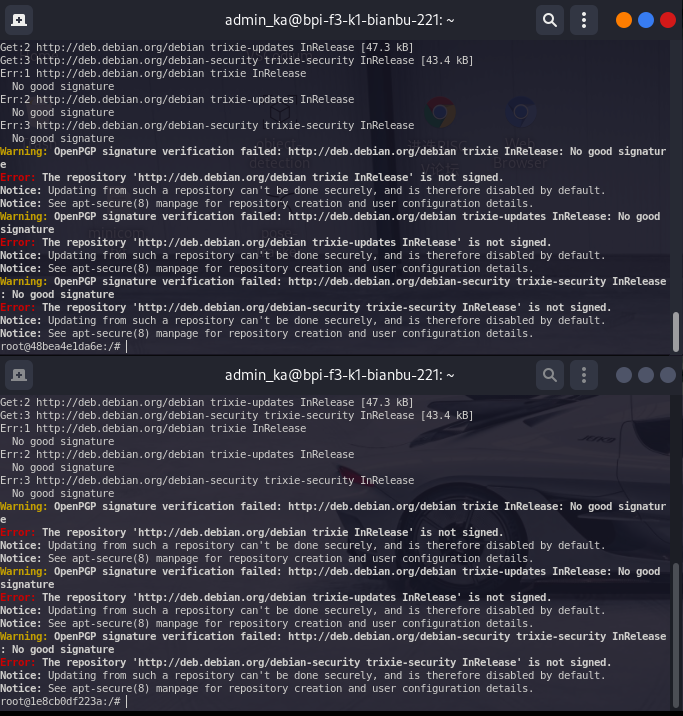
Ubuntu 24.04 containers in podman with the --privileged flag are created, updated, and allow any software to be installed without errors. However, Debian 13.3 containers are created but refuse to be updated. An error occurs. I also checked whether software can be created, updated, and installed in Docker. The Ubuntu version is created, updated, and the software can be installed, too. However, the Debian container is only created, not updated.